
A single-day $23.5 billion approval marks the largest concentrated U.S. arms sale commitment to the West Asia since the 1990-91 coalition build-up, a direct counter to Iranian attacks on regional energy infrastructure.
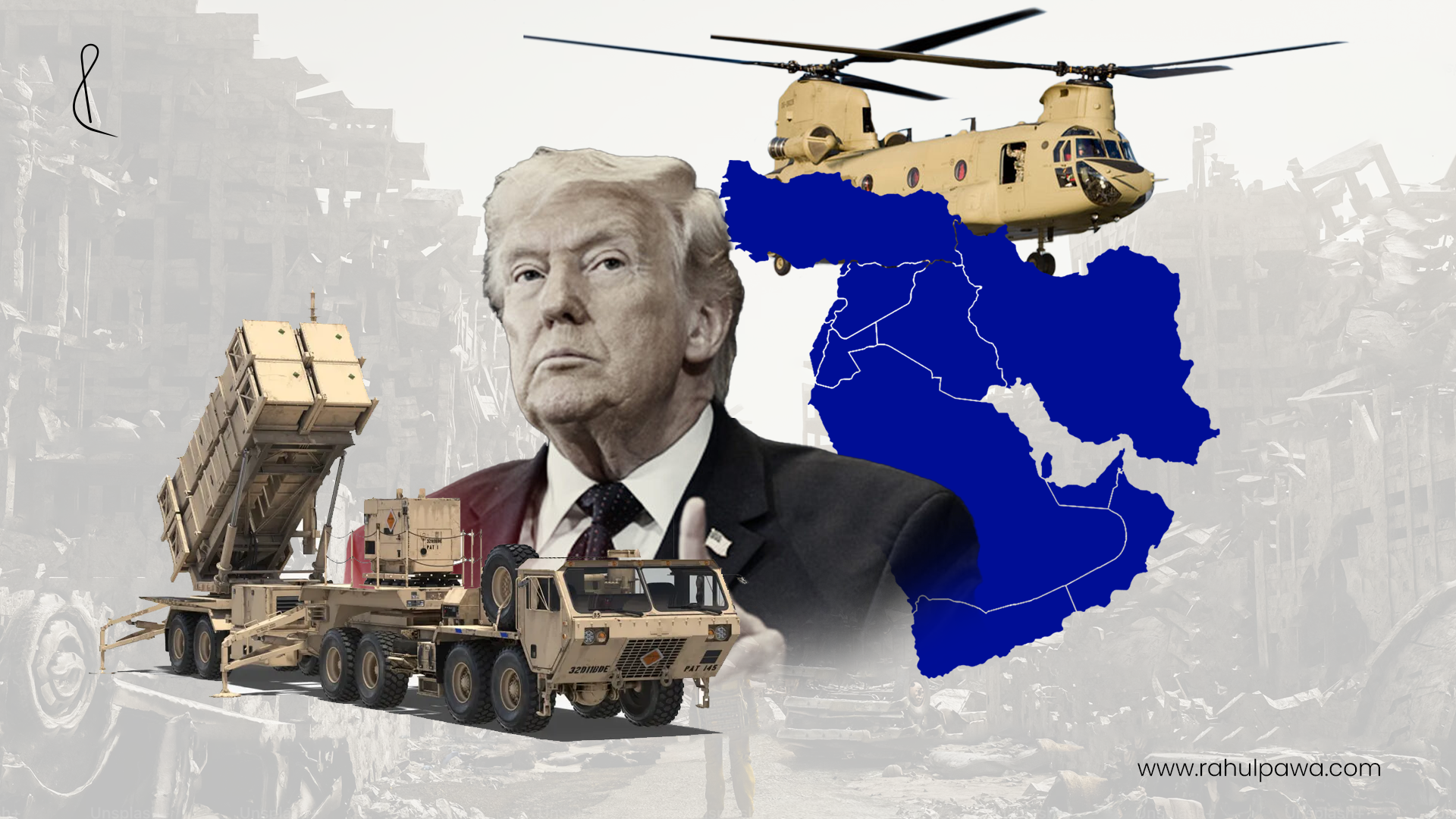
On a single day last week, Washington approved more arms for West Asia than most nations spend on defence in a decade. The $23.5 billion in potential sales cleared by the U.S. State Department on 19 March 2026, split across the UAE, Kuwait, and Jordan with a significant portion processed quietly as extensions of existing deals, did not emerge from routine procurement cycles. They were fast-tracked, and the reason is not complicated. Iran has been hitting things, and the things it is hitting matter.
Drone and missile strikes against West Asian energy infrastructure have pushed oil and gas prices higher and exposed a vulnerability that regional governments and their American patron can no longer treat as theoretical. The question of whether regional air and missile defences can absorb a sustained, multi-vector Iranian attack has moved from war-gaming seminars to operational planning desks. The 19 March approvals are Washington’s opening answer.
The headline figure for the UAE is $8.4 billion in publicly announced sales, but the real number is nearly double. An additional $7 billion, processed as expansions of earlier agreements and deliberately kept outside standard Congressional notification channels, brings the effective UAE total to approximately $17.3 billion. Within that, $5.6 billion covers Patriot PAC-3 interceptors and $1.32 billion funds CH-47 Chinook heavy-lift helicopters, with the remainder spanning missiles, drones, radar systems, and F-16 munitions and upgrades. The combination is not accidental. PAC-3 Missile Segment Enhancement variants extend engagement envelopes and improve hit-to-kill performance against manoeuvring targets, directly addressing the gap that Iranian drone saturation tactics are designed to exploit. The Chinooks are less obviously connected to air defence but no less important: when a battery must redeploy under fire and the target set shifts faster than ground transport allows, heavy-lift becomes a tactical asset rather than a logistics footnote. The F-16 elements ensure the UAE retains offensive reach. This is not a package built for passive absorption of Iranian strikes.
Kuwait’s approximately $8 billion clearance is focused on lower-tier air and missile defence sensor radars rather than interceptors, and that distinction is easily misread as less significant than the UAE’s allocation. It is not. An intercept system that cannot cue accurately is wasted hardware. Before Kuwait can field effective missile defence at scale, it needs a coherent recognised air picture, the ability to detect, track, and classify incoming threats in time to task the right effector against the right target. The sensor architecture investment establishes that upstream layer. It is preparatory rather than terminal, and the effector investment will follow. What the 19 March approval does is build the information foundation without which no subsequent kinetic capability can function reliably, and it does so at a moment when Iranian strikes on West Asian energy infrastructure have made that urgency impossible to argue against.
Jordan’s $70.5 million allocation barely registers against the other figures, and that is not a slight. Jordan’s value to the regional security architecture is geographic and logistical, a critical corridor and staging environment whose air assets need to be ready rather than numerous. The package, focused on aircraft and munitions support, is calibrated precisely to that role.
The decision to process $7 billion of the UAE package outside standard Congressional notification is legally permissible under the Arms Export Control Act, which allows the executive to structure sales as expansions of previously cleared programmes without triggering fresh legislative review. The practical effect is speed. The political risk is exposure. In a conflict where civilian casualty reporting could shift domestic opinion, the absence of a formal congressional record for nearly a third of the total commitment creates a vulnerability that has not yet become a problem but will depend entirely on how the conflict develops.
Primary contractors RTX, Northrop Grumman, and Lockheed Martin will execute the bulk of the programmes, each already managing PAC-3 production backlogs driven by European NATO restocking requirements. Adding West Asian demand of this scale to lines that are not running at surplus capacity is a scheduling problem that no approval document resolves. For newly manufactured systems, operationally meaningful delivery, integration, and crew training is unlikely to materialise in under twelve to eighteen months. Sensor packages to Kuwait may move faster.
Washington has made a strategic judgement that Iranian escalation is not a temporary spike to be waited out and that the window for hardening West Asian defences is present and finite. The 19 March approvals are the material expression of that judgement, designed simultaneously to close the capability gap that Iranian tactics have been targeting, to signal to Tehran that further escalation faces diminishing tactical returns, and to reassure West Asian governments that the U.S. security guarantee is substantive rather than rhetorical. Regional states are watching how Washington behaves under pressure. A fast-tracked, multi-billion-dollar approval package announced in direct response to Iranian strikes is the kind of signal that reassures, not because the systems will arrive tomorrow, but because the decision to send them was made today.