Over Taiwan, silence. Over West Asia, everything. The PLA’s unusual air lull after the Iran war opened is not a puzzle, it is a window into where Chinese strategic attention was actually focused.
For anyone who has tracked PLA activity around Taiwan with any regularity, the daily bulletins from the ROC Ministry of National Defense have a familiar rhythm. Since Lai Ching-te’s inauguration in May 2024, Beijing settled into a higher and more continuous pressure tempo than anything seen in prior years. Air incursions became less dependent on political flashpoints and more routine in character. The median line, once treated as a tacit boundary by both sides, was crossed with increasing regularity. Joint air-sea patrols normalised entry vectors across the southwestern, northern, and at times eastern ADIZ sectors. The pattern was deliberate: make previously exceptional behaviour unremarkable enough that no single incident could be cleanly identified as escalatory. By late 2025, analysts tracking monthly incursion data had stopped treating individual sorties as news. That is how normalised the pressure had become.
Which is precisely why eleven consecutive days of zero PLA aircraft sorties, from 1 March through 11 March 2026, registers as a pronounced anomaly. This is not the kind of variance that appears in the historical record as routine operational fluctuation. It is a clean break from an established pattern, and it coincides exactly with the opening phase of the U.S.-Israeli military campaign against Iran, which began on 28 February.
What the data actually shows
The ROC MND bulletins are unambiguous. Between 28 February and 16 March, the PLA recorded 41 aircraft sorties around Taiwan. Twenty-six of those, 63 percent of the entire period’s total occurred on a single day, 15 March. For the preceding eleven days, the number was zero, broken only by a probe of two sorties on 7 March. The PLAN surface fleet, by contrast, never stood down. Six to eight vessels maintained their patrol pattern every single day throughout the same period, producing 105 ship-presence counts across the window.
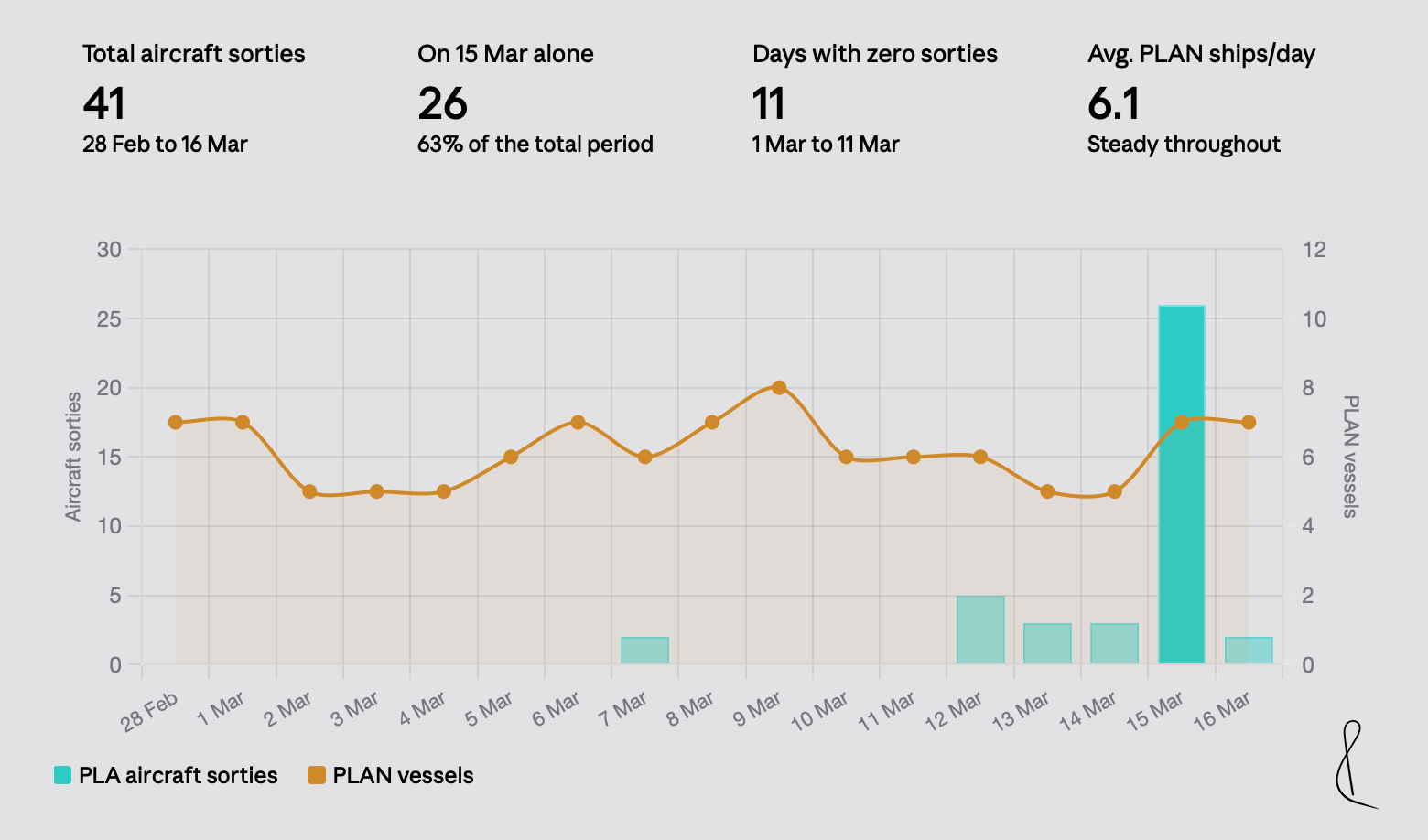
That air-maritime dissociation is the critical data point. A general stand-down would have reduced both. A logistical pause would show variance across both instruments. What the data shows instead is a deliberate choice to maintain Taiwan presence through lower-escalation naval assets while withdrawing the more operationally demanding and politically consequential air component. Ships hold position. Aircraft cross lines.
Why West Asia absorbed the attention
To understand where that attention went, it is necessary to understand what Beijing had at stake in the conflict it was watching. China is Iran’s largest trading partner and purchases an estimated 80 percent of Iranian oil exports. More than 55 percent of China’s total oil imports in 2025 came from the West Asia, approximately 13 percent from Iran itself, most of which must pass through the Strait of Hormuz. The 2021 Comprehensive Strategic Partnership between Beijing and Tehran, a 25-year agreement, positioned Iran as a critical node in the Belt and Road Initiative’s overland corridors connecting East Asia to Europe, corridors that cannot function effectively without stable access through Iranian territory. China is Iran’s largest trading partner, and the current conflict effectively closed the Strait of Hormuz, an energy artery where approximately 50 percent of Chinese energy imports transit.
Beijing’s exposure was not merely economic. China became Iran’s largest trading partner, importing significant oil volumes and providing technological support, including radar systems and navigation tools. Reports emerging from the conflict’s opening weeks indicated that Chinese material contributions, including spare parts for missile systems were helping Tehran sustain defensive operations, stopping well short of combat involvement but material enough to attract U.S. attention. Analysts described these contributions as enabling Iran to sustain its defenses without escalating to a broader confrontation involving Beijing.
Whether China was learning from the conflict or, in more limited ways, actively participating in it through a supporting role to Tehran, the strategic calculus was the same: West Asia in the opening weeks of March 2026 was where Chinese interests were most immediately at risk, and where the most consequential decisions about those interests were being made in real time.
What a live war offers that no exercise can
Separately from its direct stake in Iran’s survival, Beijing had an observational interest in the conflict that ran independently of the outcome. The U.S.-Israeli campaign represented the most significant live test of American air, naval, and command systems in a high-intensity environment since at least 2003. How carrier strike groups manage multi-axis saturation threats. How command networks absorb simultaneous kinetic, electronic, and information operations. How the decision chain from theatre commander to national command authority actually functions under real time pressure, not scripted exercise conditions.
These are the precise questions that PLA modernisation; anti-access systems, carrier-killer missiles, electronic warfare architecture, the entire military competition with the United States in the Pacific has been built around for two decades. A live conflict involving U.S. forces against an adversary operating layered air defences, ballistic missiles, and drone swarms provides data that no simulation generates. A Chinese geospatial intelligence company, MizarVision, was already circulating annotated satellite imagery of American bases in Jordan, Qatar, and Saudi Arabia within days of the campaign opening carrier positions, runway activity, logistics signatures at forward operating sites, machine-sorted and distributed in near real time. The collection infrastructure was active from the first hours.
Running high-profile air operations over Taiwan while that observational window is open is a poor allocation of military attention. The eleven-day air lull was not restraint for its own sake. It was concentration.
What is usual and what is not
Here it is worth being precise. Periodic dips in PLA air activity are not unprecedented. Operational cycles, weather, and political calendars have all historically produced short gaps. What is unusual is the duration, the timing, and the context together. An eleven-day complete absence, coinciding with the opening of a major conflict directly involving China’s most significant West Asian partner and a live test of its primary strategic adversary, falls outside any normal operational variance. It is the combination that distinguishes this from routine fluctuation. Had the Iran war not begun on 28 February, an eleven-day air lull over Taiwan would still be notable by the post-2024 baseline. In context, it is analytically significant.
Also unusual is what did not happen. The conventional expectation in Western security analysis that China would exploit U.S. military distraction by intensifying Taiwan pressure was not borne out. Beijing did not surge aircraft into the ADIZ in the war’s opening days. It pulled them back. That divergence from the expected playbook is itself a finding.
15 March signal
The lull ended on a chosen day for identifiable reasons. On 15 March, the IEA announced coordinated emergency reserve releases to counter the oil price shock from the Hormuz traffic collapse. That announcement was not merely an energy market intervention. It was institutional confirmation that the strategic and economic consequences of the Iran war were now permanent features of the environment, not temporary disruptions awaiting resolution. The United States at that moment was simultaneously managing a military campaign, an alliance stress test, a global energy supply intervention, and the full diplomatic fallout of a war that had killed an Iranian supreme leader and reshaped the West Asia’s security architecture.
Into that context, the PLA sent 26 sorties into Taiwan’s ADIZ. Sixteen of them penetrated across the northern, central, and southwestern sectors simultaneously. The geographic spread is the significant detail. Every prior sortie in the sequence had been predominantly southwestern, the standard lower-provocation entry vector. A coordinated multi-sector penetration across all three ADIZ zones requires more complex mission planning and communicates multi-axis operational capacity in a single tasking. By 16 March the count was back to two, with seven PLAN vessels continuing steady patrol. The signal was delivered and withdrawn cleanly.
Strategic read
Across the full 28 February to 16 March period, the PLA maintained Taiwan on the board through persistent naval presence while directing its air assets and command attention toward West Asia during the conflict’s most consequential opening phase. It then delivered a single concentrated, multi-axis air demonstration at the precise moment the new strategic environment became structurally confirmed, and stood down again before the signal could be read as an open-ended commitment.
That sequencing is not opportunism. It is a military and political leadership managing simultaneous theatres with deliberate prioritisation, present enough on Taiwan to hold its position, restrained enough to avoid triggering a crisis it had not chosen, and focused enough on West Asia to extract maximum value from a conflict in which it had both direct stakes and significant observational interest.
The eleven days of air silence over the Taiwan Strait were not a gap in Chinese strategic activity. By most analytical measures, they were among the busier eleven days Beijing has had in years.