
From autonomous drones to satellite killers, Pyongyang’s Ninth Party Congress signals a profound transformation in how Kim Jong Un intends to fight and win the next war.
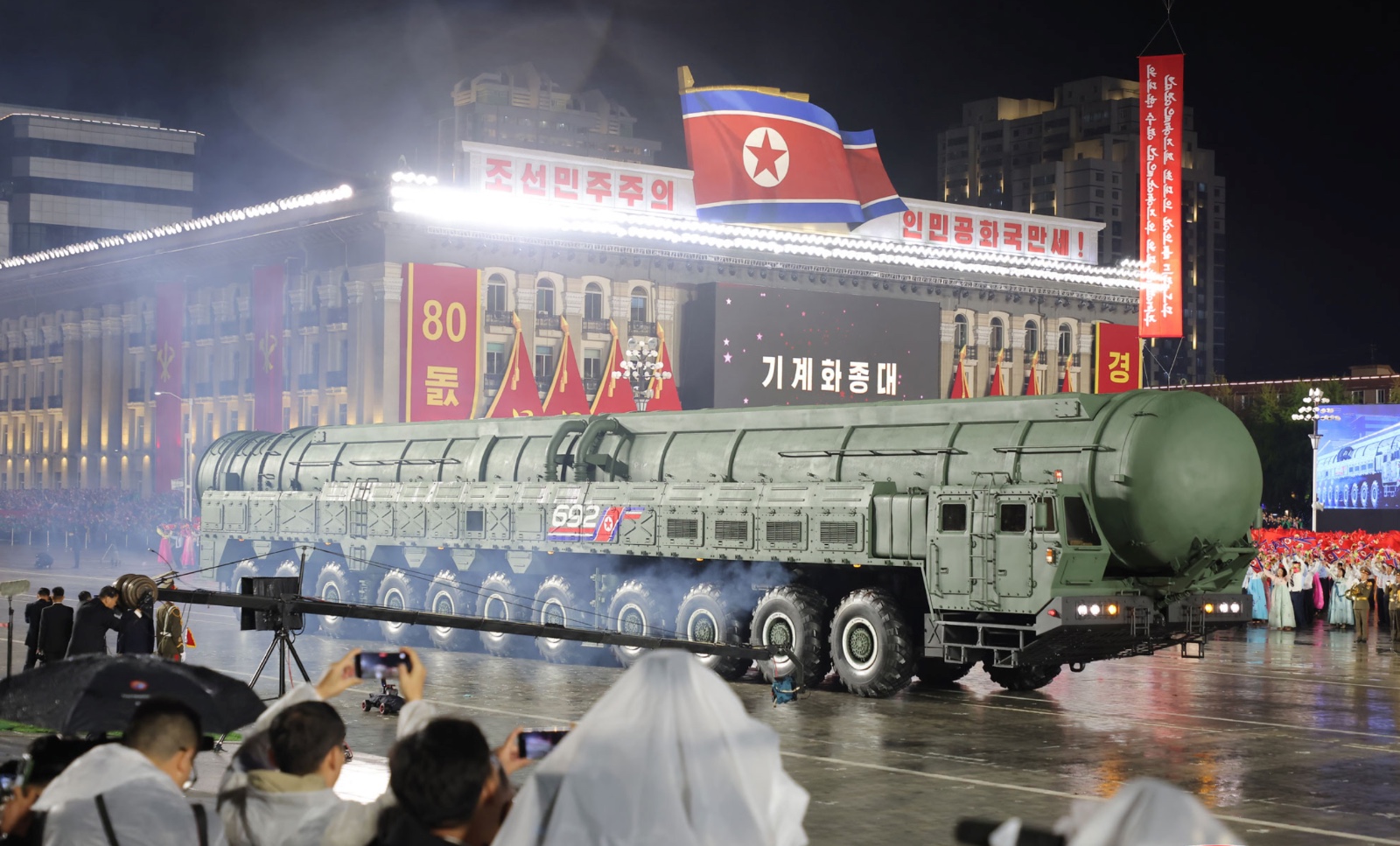 The Hwasong-20 rolls through Pyongyang during North Korea’s October 2025 Workers’ Party parade.
For decades, North Korea’s military doctrine rested on a simple, brutal calculus: overwhelming numbers, nuclear deterrence, and the willingness to absorb punishment in order to inflict it. That calculus is changing. The closing session of the Ninth Workers’ Party Congress on February 26, 2026, unveiled a five-year weapons plan that is less about raw firepower and more about intelligence, autonomy, and the ability to blind an adversary before a single missile leaves its silo. At the centre of this shift is artificial intelligence.
Autonomous Weapons: Drone Army Takes Shape
The announcement of AI-powered unmanned attack systems was not a surprise to close observers. As far back as September 2025, Kim Jong Un had visited the Unmanned Aeronautical Technology Complex and declared rapidly developing AI technology a “top priority.” By August 2025, the General Staff Department had already ordered every branch of the Korean People’s Army to submit detailed plans for AI-based combat systems, with testing scheduled to begin during winter training in December. The Party Congress was less a launch than a formal political blessing for a program already well underway.
The ambitions are broad and branch-specific. The Army is tasked with developing AI command systems that unify infantry, mechanised forces, artillery, and unmanned platforms into a single operational picture. The Navy is pursuing mixed fleets of crewed and uncrewed vessels for missions ranging from harbour defence to nuclear counterstrike scenarios. The Air Force is experimenting with formations where piloted jets fly alongside autonomous drones, a concept mirroring “loyal wingman” programs already tested by the United States and Australia. Most provocatively, Special Operations Forces have been instructed to deploy unmanned systems for assassinations, demolitions, and infiltration raids.
Hardware is already visible. The Saetbyol-4 and Saetbyol-9 drones were shown to Russian Defence Minister Sergei Shoigu during a 2023 visit. An upgraded Saetbyol-4 appeared in March 2025, featuring a new optical window and panels consistent with electronic intelligence gathering. South Korean defence officials have noted that some targeting systems on display exceed North Korea’s typical capabilities, with officials suggesting Russian technology transfer, plausible given that North Korean troops deployed to Ukraine would have gained direct exposure to modern drone warfare on a live battlefield.
Satellite Killers: Blinding the Alliance
The second pillar of Pyongyang’s AI-era military ambition is perhaps its most strategically disruptive: weapons designed to destroy enemy satellites in orbit. Kim Jong Un specifically called for the development of “special weapons for striking enemy satellites in the event of war.” The target is not abstract. US early warning satellites are the linchpin of allied missile defence on the Korean Peninsula. If Pyongyang can threaten to destroy those satellites at the outset of a conflict, the entire architecture of US, South Korean, and Japanese readiness is thrown into question.
Developing a functional anti-satellite (ASAT) weapon presents a formidable technical hurdle. A direct-ascent kill vehicle requires onboard optical, infrared, and radar sensors to steer a warhead toward a satellite moving at thousands of kilometres per hour. Even a near-miss can be effective: a fragmentation warhead creates a debris cloud that complicates or destroys the target satellite’s operations, though at the cost of polluting orbital lanes used by every other space-faring nation, including China and Russia. That collateral risk creates a rare alignment of interests between Washington, Beijing, and Moscow in opposing a North Korean ASAT capability, potentially creating diplomatic friction with Pyongyang’s closest partners.
Non-kinetic approaches; GPS jamming, laser dazzling of optical sensors, or cyberattacks on satellite ground control stations remain closer to North Korea’s existing capabilities and would carry fewer of the debris risks. North Korea already operates GPS jammers on mobile platforms, a capability demonstrated intermittently since the 2010s. Scaling that logic upward to space denial is a natural doctrinal evolution.
The Deeper Implication: AI and the Nuclear Trigger
Beyond drones and satellite weapons lies a more unsettling dimension of North Korea’s AI ambitions: the integration of artificial intelligence into nuclear command and control. Plans have reportedly been issued to incorporate AI across a four-stage nuclear operational cycle, from managing warhead storage sites to coordinating launches and planning counterstrikes. No credible evidence suggests North Korea is close to fully automating nuclear decision-making, but the direction of travel is alarming. The combination of autonomous weapons, degraded early-warning satellites, and AI-assisted nuclear command could compress crisis timelines in ways that leave human judgement with no meaningful role.
What emerges from the Ninth Party Congress is a coherent, if deeply dangerous, strategic vision. North Korea is not simply trying to build more weapons. It is trying to build smarter ones, systems designed to blind, overwhelm, and outpace an adversary whose technological edge has, until now, made conventional North Korean military power largely irrelevant in any prolonged conflict. The AI-fication of the North Korean arsenal may still be years from operational maturity. But the direction is set, the political mandate is given, and the resources are being committed. The alliance watching from Seoul, Tokyo, and Washington would do well to take it seriously.