
February 24, 2025

International Affairs

How CCP is Architecting a New World Order

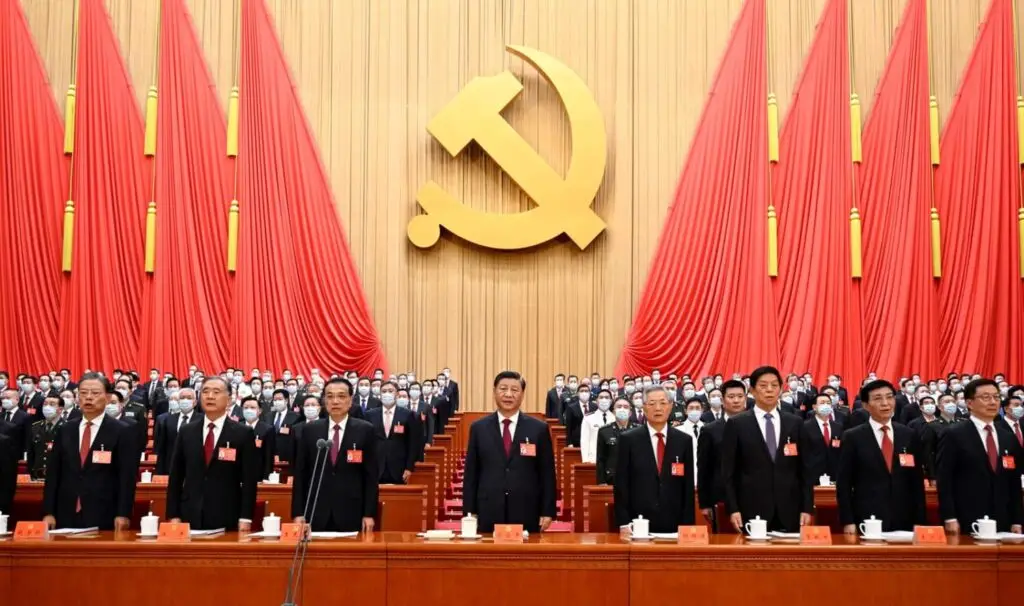
CCP is positioning itself not just as a regional power but as the central player in an emerging new world order. With every move, Beijing is sending a clear signal: the era of Western dominance is drawing to an end, and China’s moment has arrived. In recent years, Chinese Communist Party (CCP) has embarked on a series of bold, strategically transformative initiatives that are not only reshaping global order but also redefining the very concept of national security. Seizing the moment, Beijing has advanced a comprehensive strategy aimed at strengthening its position while challenging post-Cold War world order that has long been dominated by Western powers. The scope of Beijing’s ambitions has expanded to unprecedented levels—ranging from large-scale infrastructure projects spanning continents to advancements in technology and energy. Each initiative showcases a determined effort to reposition China at the centre of a new global hierarchy. Unfolding, an era of calculated moves, technological breakthroughs, and strategic posturing, all of which are poised to fundamentally shift global power dynamics and shape international landscape for decades to come. It started with a quiet, yet signifiant move into the heart of Africa. Under Belt and Road Initiative, a series of 30 clean energy projects has begun to take shape across the continent, weaving a complex web of CCP influence in countries long neglected by the West. Solar farms, wind turbines, and hydroelectric plants are rising where darkness and poverty once reigned, promising economic growth and energy independence. To many, it seems like the kind of philanthropy the world needs—Beijing is playing the role of the benevolent superpower, offering solutions where others have failed. Yet, as Beijing’s footprint expands, its motives become clearer. This is not just about lighting up villages or building infrastructure—it’s about creating a sphere of influence. The “Green Silk Initiative,” as some have called it, is a tool for political leverage, an economic dependency cloaked in the rhetoric of environmentalism and mutual benefit. For the CCP, Africa’s energy future is not just about growth; it’s about aligning a vast continent with its own vision for the global order, a vision that has no place for Western hegemony. Simultaneously, high in the Tibetan plateau, another monumental CCP project is taking shape—one that threatens to reshape the region’s future and leave its critics scrambling for answers. The CCP’s proposed hydropower dam, set to generate 300 billion kilowatt-hours annually, is poised to become the world’s largest hydropower project, with an estimated cost of $137 billion. Beyond the eye-popping numbers, the scale of this project has sparked intense controversy. Tibetan exiles and environmental groups warn that the dam could irrevocably damage fragile ecosystems and desecrate landscapes that have been sacred for centuries. The Dalai Lama, exiled since the CCP’s occupation of Tibet, has repeatedly voiced concerns, cautioning that such large-scale developments, masked as progress, would scar a land steeped in ancient culture and unparalleled natural beauty. For many, the dam is not simply an energy project—it is a symbol of cultural and ecological destruction, a stark manifestation of a regime willing to sacrifice the sacred in its relentless pursuit of power. The ambitions of the CCP, however, extend far beyond energy and infrastructure, reaching into the very heart of technological advancement. The unveiling of the CR450 high-speed train serves as a striking demonstration of China’s emerging engineering prowess, as well as a symbol of its strategy to dominate the global transportation landscape. The CR450, now recognised as the world’s fastest train, is more than a marvel of modern engineering—it is a direct challenge to the West’s technological supremacy. Designed to connect major cities across China with unprecedented speed and efficiency, the train cuts through the landscape with such force that it feels less like a transportation system and more like a statement. The rapid development and deployment of such projects place Beijing not only at the cutting edge of infrastructure but in a strategic position to export its technology globally, further entrenching its economic and political reach across the globe. This is not a game of pure infrastructure, however. As much as the CCP seeks to dazzle the world with its technological feats, it also seeks to control the future of energy and power itself. The “Artificial Sun” project, another CCP innovation, has captured the global imagination. Under the banner of the Celestial Fusion programme, Chinese scientists recently set a world record by sustaining plasma for an unprecedented 1,066 seconds. This achievement, presented with immense fanfare by the Chinese state, positions the China as a leader in the race for clean, limitless energy. But in many ways, the artificial sun represents more than just a scientific breakthrough. For many critics, it is a carefully choreographed piece of state-sponsored propaganda, designed to project power and technological dominance. CCP is positioning itself not just as a global economic power but as a potential monopoly on the energy sources of the future. The implications of such a shift cannot be understated. The ability to control global energy markets and dictate terms for future energy access will fundamentally reshape the power structures of the 21st century. Beijing’s naval ambitions, too, have grown exponentially. The unveiling of the Type 075 amphibious assault ship is a powerful signal of the CCP’s People’s Liberation Army (PLA) growing military might and its intent to dominate the seas. This vessel, one of the largest of its kind, is capable of deploying large forces quickly and efficiently across vast stretches of the ocean. The message is clear: CCP is ready to assert itself as a maritime power capable of protecting its interests in critical regions such as the South China Sea, where tensions with Southeast Asian nations and the United States have been escalating for years.The Type 075, with its cutting-edge technology and imposing size, epitomises Beijing’s broader naval ambitions to challenge both South Asian and Western naval presences in the region. More than just a weapon, the ship serves as a floating symbol of Beijing’s power projection—an embassy on water, reinforcing the message

Popular Blogs​

DeepSeek, ChatGPT, and the Illusion of an AI Supremacy: Real Story Behind the U.S. Outrage

Next generation of AI breakthroughs will not necessarily emerge from trillion-dollar companies with exclusive access to compute power. Instead, they will come from those who can best refine, iterate and optimise open-source research. This is why the reaction in the U.S. is so intense. DeepSeek, particularly its “R1” model, sent a subtle tremor through the U.S. tech elite—one that quickly escalated into a storm. The Chinese-developed AI’s remarkable efficiency rattled Silicon Valley, with analysts bracing for yet another chapter in the intensifying technological arms race between the two tech powers. However, the real story isn’t China outpacing the U.S. in AI—this understanding is flawed. The true takeaway lies not in AI Supremacy but in rising influence of open research and open-source development, which are rapidly outpacing proprietary AI models. For years, the prevailing wisdom in Silicon Valley was that AI supremacy was dictated by scale and infrastructure. OpenAI’s ChatGPT, built on the Generative Pre-trained Transformer (GPT) model, was the epitome of this approach. It was trained on vast datasets, fine-tuned with Reinforcement Learning from Human Feedback (RLHF), and required enormous computational resources to function. ChatGPT’s dense Transformer architecture meant that every interaction activated all of its parameters, demanding substantial compute power, data centers, and high-end GPUs to sustain its performance.This resource-heavy approach made large-scale AI development an exclusive domain of tech giants. The assumption had long been that only organisations with billion-dollar budgets and state-of-the-art infrastructure could build competitive AI models. The underlying premise was that the future of AI would be controlled by those who could invest the most in proprietary architectures and data ecosystems. Then came DeepSeek, and with it, an unexpected disruption to this model. Unlike ChatGPT’s dense Transformer framework, DeepSeek employs a Mixture-of-Experts (MoE) architecture, an approach that activates only the most relevant subnetworks for each task. Instead of engaging all model parameters indiscriminately, DeepSeek selects only a subset of specialised expert networks, dramatically reducing computational costs while maintaining high performance. This efficiency allows DeepSeek to deliver state-of-the-art AI capabilities without the infrastructure overhead required by proprietary models like ChatGPT. But the real disruption is not just in DeepSeek’s technical design—it is in how it was built. DeepSeek did not emerge from secrecy. It was not necessarily developed in a classified government lab or through covert data acquisition. Instead, it was built using open-source tools and publicly available research—much of it originating from the West. The foundation of DeepSeek’s success is not Chinese innovation but the power of open-source AI research. It leveraged, Meta’s Llama, an open-source large language model whose architecture was freely available. PyTorch, a deep-learning framework widely used in AI development, originally developed by U.S. researchers. Mixture-of-Experts research, openly published in Western academic AI circles. China did not need to steal AI advancements—it simply used what was freely available, improved upon it, and released an optimised version. This is the real source of Silicon Valley’s unease. If DeepSeek can leverage open-source AI research, refine it, and deploy a highly efficient model at scale, then the playing field is no longer dictated by who has the largest dataset or the most compute power. The realisation that AI’s future is no longer monopolised by a few Western corporations is what is truly unsettling the industry. DeepSeek is simply the first proof of a larger trend: open-source AI models are overtaking proprietary ones in agility, accessibility, and efficiency. The AI race is no longer about who has the most resources, but who can most effectively iterate and optimise open research. The implications extend beyond economics and corporate dominance—they reach into geopolitics and national security. For years, the U.S. has sought to contain China’s AI ambitions through restrictions on high-performance semiconductor exports. The Biden administration imposed strict controls on the sale of Nvidia’s A100 and H100 AI chips to China, believing that limiting access to cutting-edge hardware would slow its AI development. But DeepSeek challenges that assumption. If AI can be built more efficiently, then hardware limitations become less of a bottleneck. DeepSeek suggests that AI models do not necessarily need massive compute power to be competitive—they need smarter, more efficient architectures. If this is true, then U.S. export restrictions may not be as effective as previously believed. Yet, to frame this purely as a U.S.-China competition misses the broader transformation taking place. DeepSeek is not a singular national achievement—it is evidence of a fundamental shift in AI development. The next generation of AI breakthroughs will not necessarily emerge from trillion-dollar companies with exclusive access to compute power. Instead, they will come from those who can best refine, iterate, and optimise open-source research. This is why the reaction in the U.S. is so intense. The fear is not that China alone has built a better model, but that the monopoly on AI development itself is weakening. If DeepSeek’s efficiency proves sustainable, then the assumption that AI innovation belongs only to the wealthiest institutions is no longer valid. DeepSeek doesn’t signal the U.S. losing its AI edge—it marks the broader shift that AI development is decentralising. The future of artificial intelligence will not be dictated by who has the largest corporate lab or the deepest computing resources, but by who is willing to embrace collaboration, efficiency, and open knowledge. Silicon Valley’s response to DeepSeek is telling. It is not about a loss of American technological superiority but about a loss of control over the AI narrative. The shift toward open-source AI threatens the dominance of proprietary models, and that is what has set off the alarm bells in Washington and within the ranks of major AI corporations. Lastly, DeepSeek is not an endpoint—it is a harbinger of what is to come. The AI revolution is moving faster than anticipated, not because of geopolitical competition, but because of the power of shared knowledge. The next phase of AI will be defined not by who builds the biggest model, but by who can most effectively harness and refine what is already available to everyone. The U.S. outrage over DeepSeek

Scroll to Top